


Why is Legionella prevention important?
Legionella are bacteria that thrive particularly well in warm water and can be inhaled through aerosols. They cause a dangerous Legionellosis (Legionnaires' disease). Hot water systems in residential buildings, hotels, hospitals, or industrial facilities are particularly vulnerable. A proven method of prevention is UVC disinfection, which works without chemical additives and allows for continuous water sterilization.
How does UVC disinfection work against Legionella?
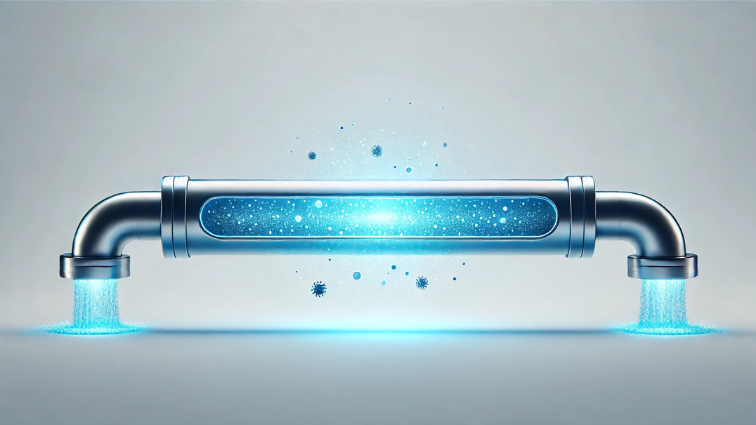
The UVC technology uses ultraviolet light with a wavelength of approximately 254 nm to destroy the DNA and RNA of Legionella. This renders the bacteria unable to reproduce and harmless. The UVC unit is installed in the hot water circulation system and irradiates the flowing water, keeping it germ-free.
Challenges and Opportunities of UVC Disinfection in Hot Water Systems
Challenges
- Circulation systems provide a breeding ground for biofilms in poorly circulated pipe sections. UVC only irradiates the flowing water, not the adhering biofilms.
- The irradiation duration should be sufficiently long. A correctly sized UVC system is crucial for killing efficiency.
- Regular maintenance is essential, as the lamp's performance decreases over time and must be renewed in a timely manner.
Opportunities
- Chemical-free disinfection is free from harmful by-products and chloramines.
- Immediate effect prevents the multiplication of Legionella directly upon contact with the radiation.
- Sustainable solution requires only electrical energy for lamp operation; costs for chemicals are eliminated.
Comparison with Other Methods
Thermal Disinfection
Heating the water to at least 70 °C kills Legionella.
- Advantages: Immediate germ killing at sufficient temperature, no additional devices with a suitable system.
- Disadvantages: High energy demand, possible material damage due to high temperatures, no lasting effect as Legionella can grow again after cooling.
Chemical Disinfection (Chlorination, Chlorine Dioxide, Hydrogen Peroxide)
Killing occurs through disinfectants that flow through the system.
- Advantages: Also targets biofilms in the pipes, long-term depot effect possible.
- Disadvantages: Risk of harmful by-products, changes in taste and smell of the water, higher maintenance effort for control and dosing.
Conclusion
UVC disinfection is an efficient, chemical-free, and environmentally friendly method to reduce Legionella in hot water systems. It is particularly effective in well-flowing systems but only partially reaches adhering biofilms. A combination with thermal or chemical processes enables comprehensive Legionella prevention. For energy-efficient buildings and sustainable water treatments, UVC presents a promising alternative to conventional methods.


